
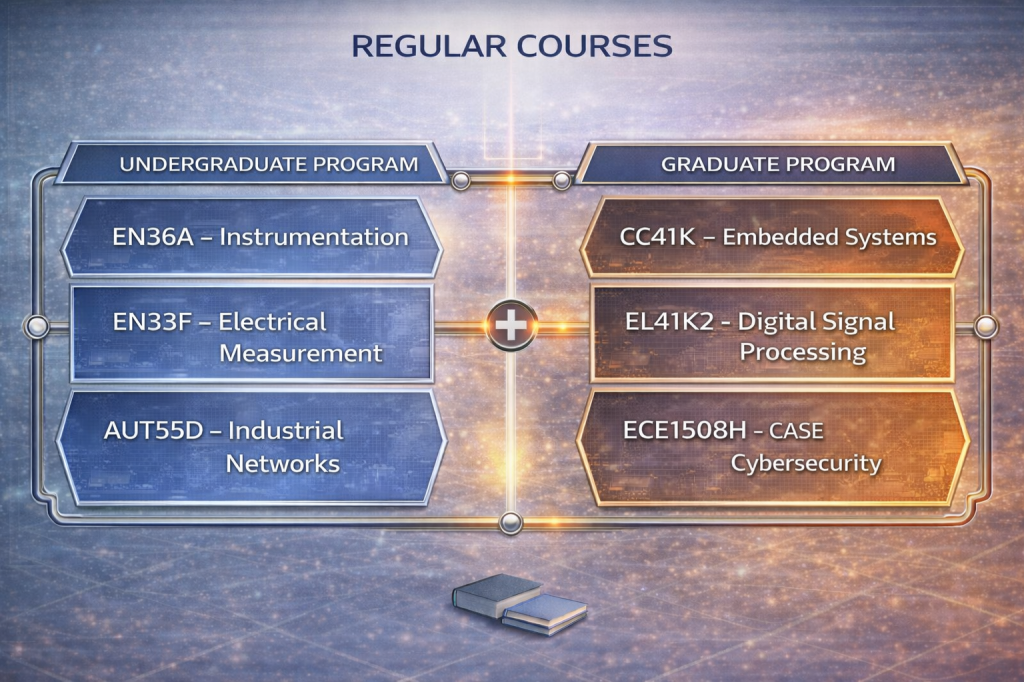
Regular Courses (Available Materials)
Undergraduate Program
EN36A – Instrumentation
EN33F – Electrical Measurement
AUT55D – Industrial Networks
Tech Training
Philosophy for Industry – Grounded in Real Engineering, Safety, and Applied Innovation
My training philosophy for industry is founded on the conviction that high-impact engineering emerges from the integration of solid theoretical foundations, real industrial practice, and strong standards awareness. In critical sectors such as automotive, intelligent mobility, energy, and cyber-physical systems, it is not sufficient to simply understand emerging technologies—professionals must be able to design, validate, test, certify, and operate complex systems with safety, efficiency, and traceability.
All training programs I offer are structured to bridge the gap between academic knowledge and real industrial application, incorporating:
- Real case studies from OEMs and Tier-1 suppliers
- Industrial tools and processes (MATLAB/Simulink, CANoe, CANape, HIL, SIL, Model-Based Design)
- International standards and regulations (ISO 26262, ISO 21448 – SOTIF, ISO 21434, ASPICE)
- A systemic perspective integrating system, software, hardware, data, safety, and business considerations
The objective is not merely to “teach technology,” but to empower professionals to make sound technical decisions in high-responsibility environments, preparing teams to:
- Develop safe and secure systems from the earliest design stages (safety & security by design)
- Accelerate innovation without compromising certification and compliance
- Correctly interpret failures, risks, uncertainties, and system limitations
- Apply artificial intelligence and automation in a reliable, explainable, and certifiable manner
Each course can be delivered in experts, executive, technical, or hands-on formats, tailored to the audience level (engineering teams, technical management, or leadership), always emphasizing immediate applicability within the company’s operational context.
Portfolio of Industry Training Programs
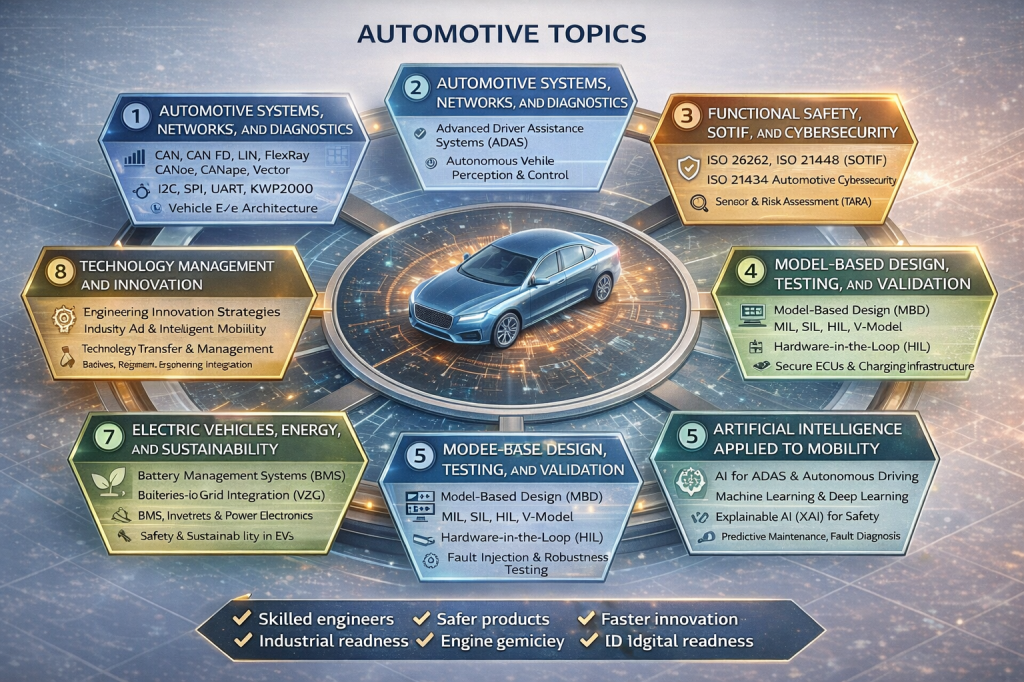
1. Automotive Systems, Networks, and Diagnostics
- Methods and Processes for Analysis and Testing of Automotive CAN Networks
- CAN, CAN FD, LIN, FlexRay, and Automotive Ethernet
- Communication Protocols: I2C, SPI, UART, GPIO, and CAN
- Automotive Diagnostics (UDS, J1939, KWP2000)
- Vehicle Electrical and Electronic Architectures (E/E Architecture)
- Automotive Instrumentation and Data Acquisition
2. ADAS and Autonomous Driving (AD)
- Advanced Driver Assistance Systems (ADAS): Architecture, Control, and Testing
- Autonomous Vehicles: Architecture, Perception, Decision-Making, and Control
- Automotive Sensors: Camera, Radar, LiDAR, and Sensor Fusion
- Perception and Object Tracking Algorithms
- ADAS Validation in SIL, HIL, and Vehicle Testing
- Scenario-Based Testing for ADAS and Autonomous Driving
3. Functional Safety, SOTIF, and Cybersecurity
- ISO 26262 – Automotive Functional Safety (from concept to validation)
- ISO 21448 – SOTIF for ADAS and Autonomous Vehicles
- Risk, Uncertainty, and Functional Limitation Analysis
- Automotive Cybersecurity – ISO 21434
- Vehicle Network and ECU Security
- Threat Analysis and Risk Assessment (TARA)
- Security for Connected Vehicles and Charging Infrastructure (EVSE)
4. Model-Based Design, Testing, and Validation
- Model-Based Design (MBD) for Automotive Systems
- MIL, SIL, HIL, and V-Model in practice
- Hardware-in-the-Loop (HIL) for Automotive Systems
- Automated Testing and Regression Strategies
- Fault Injection and Robustness Validation
- Digital Twins for Vehicle Validation
5. Artificial Intelligence Applied to Mobility
- AI for ADAS and Autonomous Vehicles
- Machine Learning and Deep Learning for Vehicle Perception
- Explainable AI (XAI) in Safety-Critical Systems
- Vehicle Data Usage for Optimization and Diagnostics
- Large Language Models (LLMs) for Automotive Engineering and Embedded Systems
- AI for Predictive Maintenance and Fault Diagnosis
6. Embedded Systems and Automotive Software
- Automotive Embedded Software Architectures
- AUTOSAR Classic and Adaptive
- Software-Defined Vehicles (SDV)
- Hardware/Software Co-Design
- Real-Time Systems and Scheduling
- Software Engineering for Safety-Critical Systems
7. Electric Vehicles, Energy, and Sustainability
- Electric Vehicle Architectures (BEV/HEV)
- Batteries, BMS, and Power Electronics
- Energy Management and Control Strategies
- Vehicle-to-Grid (V2G) Integration
- Safety and Reliability in Electrified Systems
8. Technology Management and Innovation
- Engineering-Driven Technology Innovation Management
- Integration of Engineering, Business, and Regulation
- R&D Strategies for Industry 4.0 and Intelligent Mobility
- Technology Transfer and Industrial Innovation
- Development of Technical Leadership in Advanced Engineering
Training Differentiators
✔ Content grounded in real projects with OEMs and Tier-1 suppliers
✔ Strong integration of engineering, standards, and innovation
✔ Hands-on approach combined with strategic vision
✔ Clear focus on safety, certification, and industrial deployment
✔ Training that builds technical autonomy and confident decision-making
 maxmauro.com