
Industry Consulting Approach
My consulting approach for industry is engineering-driven, system-level, and results-oriented, designed to bridge the gap between advanced research, industrial constraints, and deployable solutions. Rather than offering generic advisory services, I work closely with technical, managerial, and executive teams to diagnose real system problems, co-design solutions, and guide implementation in compliance with industrial standards, safety regulations, and business objectives.
The core principle of my consulting is that innovation must be feasible, certifiable, and scalable. Every engagement is grounded in a deep understanding of the client’s operational context—hardware, software, processes, people, and regulatory environment—combined with state-of-the-art methods in embedded systems, AI, ADAS, cybersecurity, electrification, and intelligent transportation. The goal is not only to solve an immediate problem, but also to build internal capability, technical maturity, and long-term innovation capacity within the organization.
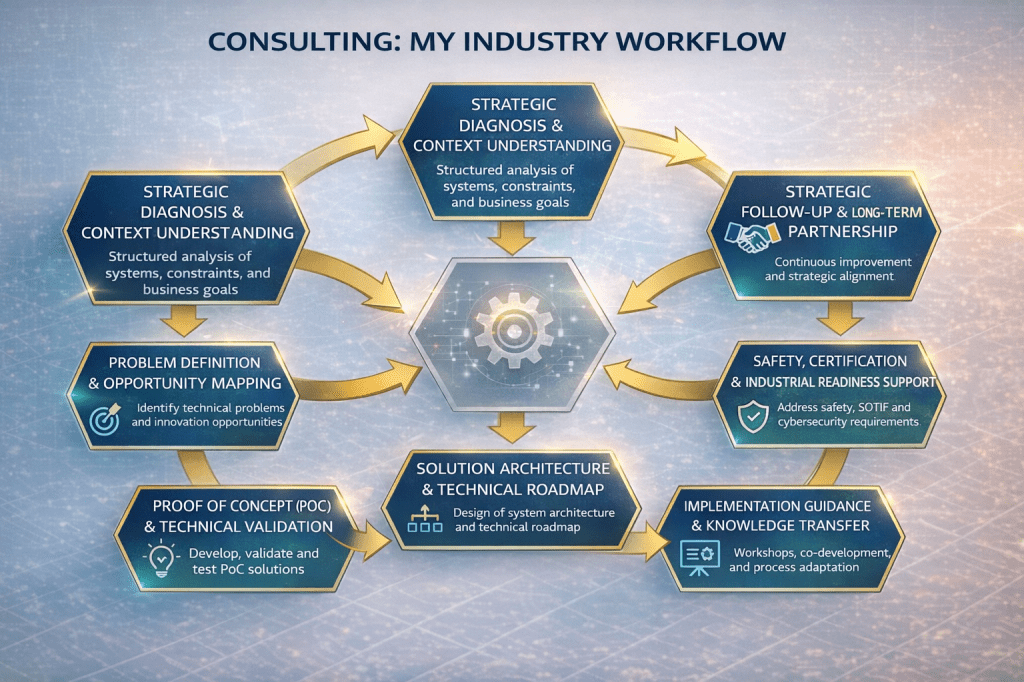
Consulting Workflow (End-to-End)
1. Strategic Diagnosis & Context Understanding
The consulting process begins with a structured technical and organizational diagnosis. This phase focuses on understanding:
- The product, system, or platform under development
- Current technical architecture (HW, SW, networks, data flows)
- Development processes, validation practices, and toolchains
- Safety, cybersecurity, and regulatory constraints
- Business goals, timelines, and market pressures
This step ensures that recommendations are context-aware and industry-realistic, avoiding purely academic or disconnected solutions.
2. Problem Definition & Opportunity Mapping
Based on the diagnosis, key technical and strategic challenges are formally defined. These may include:
- Performance or reliability limitations
- Safety or SOTIF gaps
- Cybersecurity vulnerabilities
- Inefficiencies in development or validation workflows
- Difficulties in adopting AI, autonomy, or electrification
At the same time, innovation opportunities are identified—where advanced methods (AI, model-based design, digital twins, SOA, edge intelligence) can generate measurable value.
3. Solution Architecture & Technical Roadmap
In this phase, a system-level solution architecture is proposed. This includes:
- Definition of target architecture (HW/SW/AI/communication)
- Selection of technologies, tools, and platforms
- Alignment with standards (ISO 26262, ISO 21448, ISO 21434, ASPICE, UNECE)
- Definition of integration points with legacy systems
A technical roadmap is delivered, showing short-, medium-, and long-term steps, risks, dependencies, and expected outcomes.
4. Proof of Concept (PoC) & Technical Validation
When appropriate, the consulting includes hands-on support for:
- Proof-of-concept development
- Prototyping (simulation, SIL, MIL, HIL, or vehicle tests)
- Algorithm validation (AI, control, perception, cybersecurity)
- Toolchain integration (MATLAB/Simulink, ROS2, CANoe, embedded targets)
This phase reduces uncertainty and de-risks strategic decisions before large investments.
5. Implementation Guidance & Knowledge Transfer
Rather than delivering “black-box” solutions, the consulting emphasizes knowledge transfer, including:
- Technical workshops and training sessions
- Co-development with internal engineering teams
- Documentation of architectures, methods, and best practices
- Support in adapting internal processes and workflows
The objective is to leave the organization stronger, more autonomous, and technically mature after the engagement.
6. Safety, Certification & Industrial Readiness Support
For safety-critical domains, the consulting explicitly addresses:
- Safety concept development and reviews
- SOTIF and scenario-based validation strategies
- Cybersecurity risk analysis and mitigation
- Evidence generation for audits and certification
This ensures that innovation is not blocked later by compliance or regulatory issues.
7. Strategic Follow-Up & Long-Term Partnership
Finally, consulting engagements may evolve into long-term partnerships, supporting:
- Continuous improvement of products and platforms
- Scaling solutions across programs or vehicle lines
- Joint R&D projects, funding proposals, and innovation programs
- Roadmapping for future technologies and markets
Key Differentiators of This Consulting Model
- Deep technical expertise + industrial realism
- System-level thinking (not isolated components)
- Strong focus on safety, standards, and certification
- Hands-on engineering support, not only advice
- Knowledge transfer and capability building
- Alignment between technology, strategy, and business impact
 maxmauro.com